Actionable Intelligence
From advisory to patch list: one CISA advisory, one inventory, and what the graph adds
On 8 October CISA published advisory AA26-281A, Chinese Government-linked Cyber Threat Actors Combine Automated and Hands-on Hacking Tools to Steal Sensitive Data. Like most CISA advisories, it comes with a STIX 2.1 file: 1,575 objects, including 773 indicators, 25 ATT&CK techniques, 8 CVEs, 8 pieces of malware and tooling, and three threat actors (Flax Typhoon, Integrity Technology Group, and “China-Nexus”).
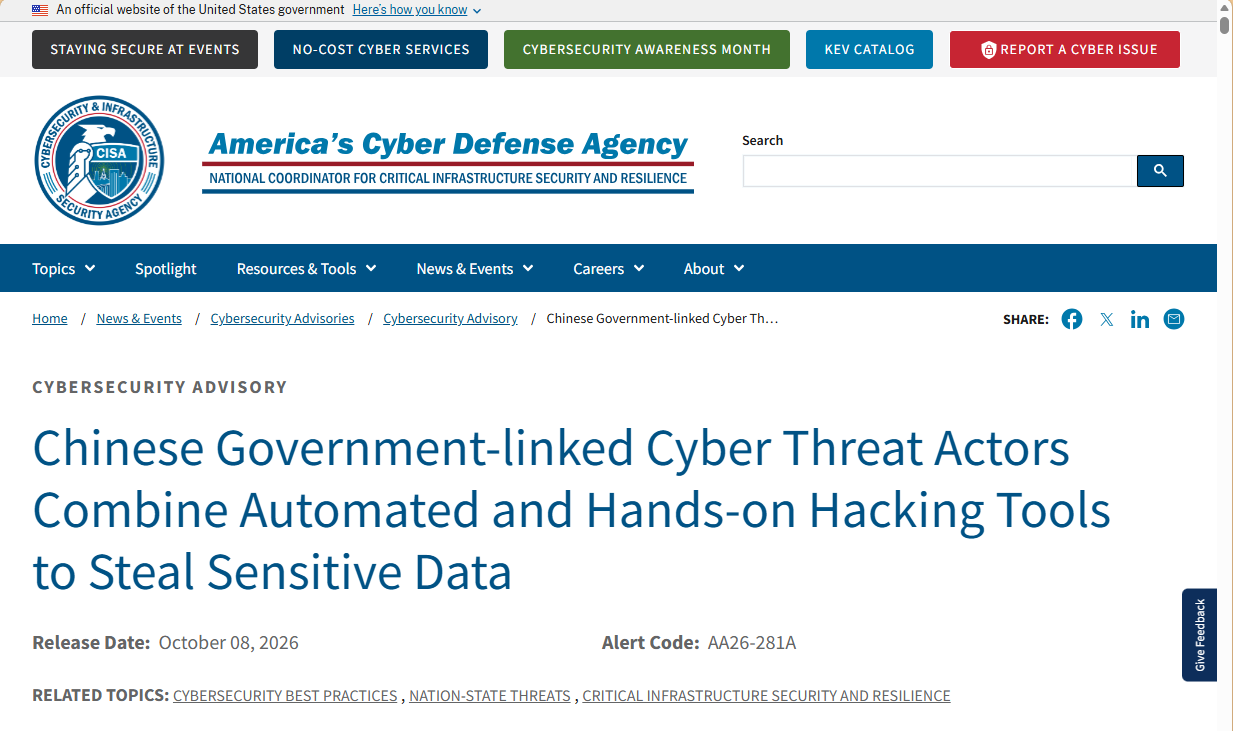
Every security team that reads it has the same question: which of our systems does this put at risk, and what do we do first?
The STIX file can’t answer that on its own. It describes the adversary. It knows nothing about your environment, and it says little about the CVEs and techniques it mentions beyond their names. The answer lives in the connections between the advisory, your inventory, and the body of public knowledge about vulnerabilities, weaknesses, attack techniques and controls.
That’s what I’ve been building Moai to do. This post walks through the whole thing with AA26-281A, start to finish.
The pieces
- The CTI Encyclopedia: a knowledge graph of more than 50 million facts, drawn from NVD’s CVEs and CPE products, MITRE’s CWE, CAPEC and ATT&CK, and NIST SP 800-53, with the connections between them made explicit: this CVE affects that product, exploits this weakness, and this control mitigates that technique.
- STONEWORK: the open ontology the Encyclopedia is built on. It extends STONES, a faithful OWL rendering of STIX 2.1, with the concepts STIX doesn’t have: products, weaknesses, controls, investigations, hypotheses, analyst opinions. (github.com/Cyber-Terrain-Ontology/stonework)
- Moai: the analyst’s workspace on top. Cases, imports, links to the Encyclopedia, and plain-English questions through AllegroGraph’s GraphTalker.
For the demo I built a small, made-up inventory for a “regional operations” network: four products in an SBOM. Ivanti Connect Secure 9.0R2.1, GitLab Community Edition 13.10.2, Strapi 4.5.0 and PostgreSQL 15.4.
1. Open a case
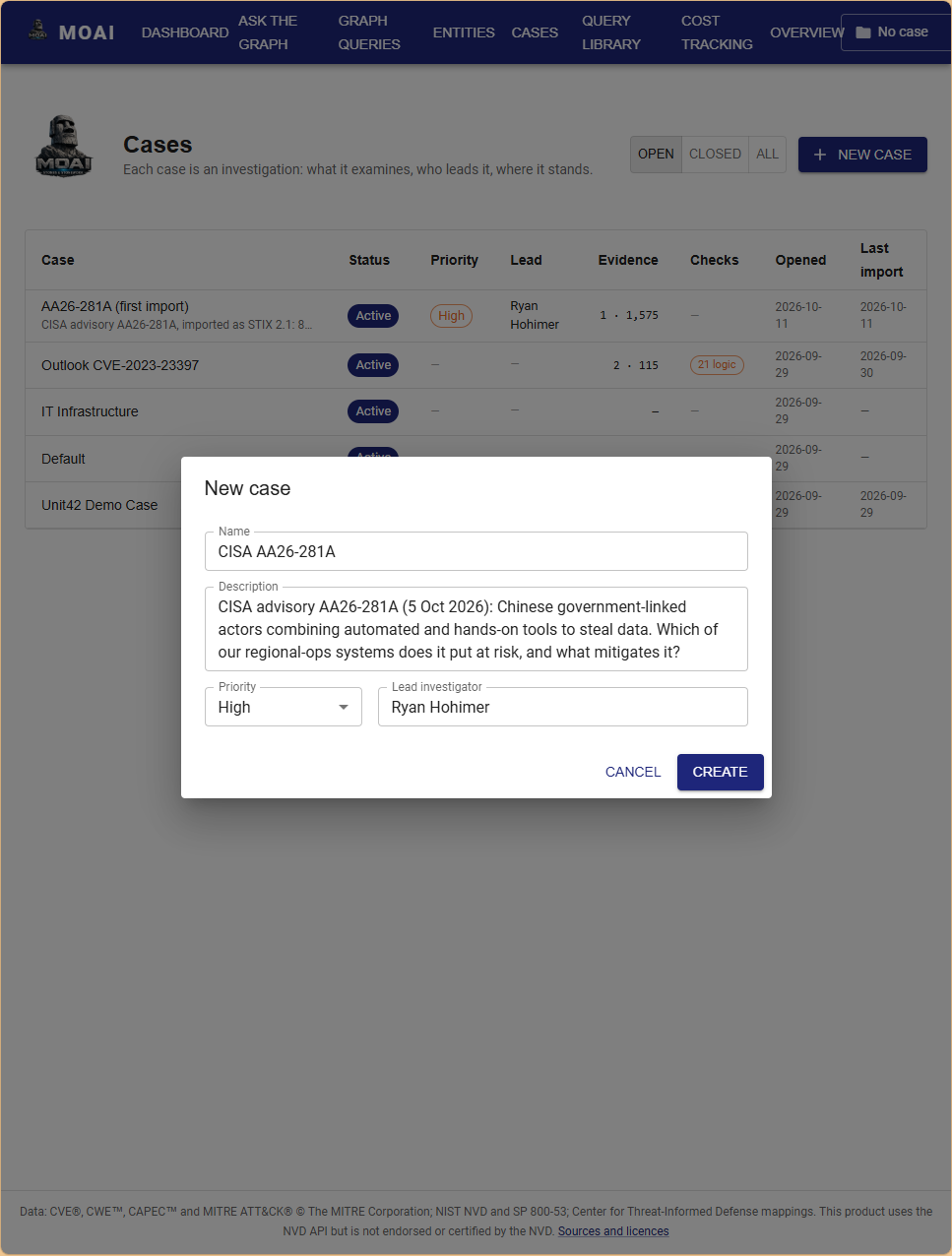
A case in Moai isn’t an app record. It’s a stonework:Investigation: its status, priority, lead investigator, and opening and closing dates are facts in the graph, in the same vocabulary as everything else. That matters later, because anything that can read the graph, including the AI assistant, can read the case.
2. Import the advisory, and check it
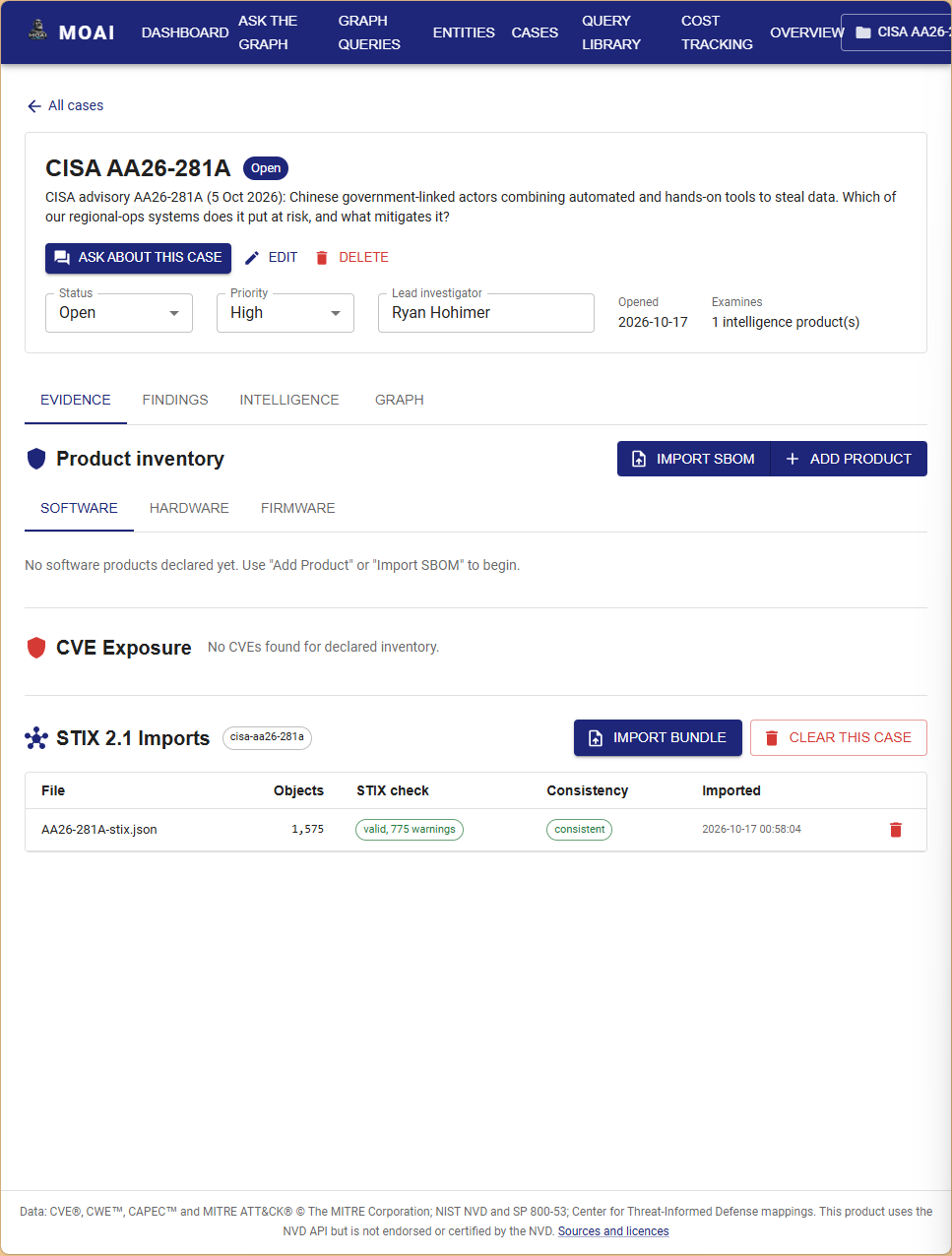
Moai runs two checks on every import and keeps both reports with the case:
- Is it valid STIX? Checked with the OASIS validator. AA26-281A is valid, with 775 warnings: 773 indicators have neither a name nor a description, which the spec says they SHOULD have.
- Is it consistent with what we already know? The imported facts are checked against the STONEWORK ontology and the Encyclopedia for contradictions: something that would have to be two disjoint kinds of thing, or a property with two values where only one is allowed. AA26-281A is consistent.
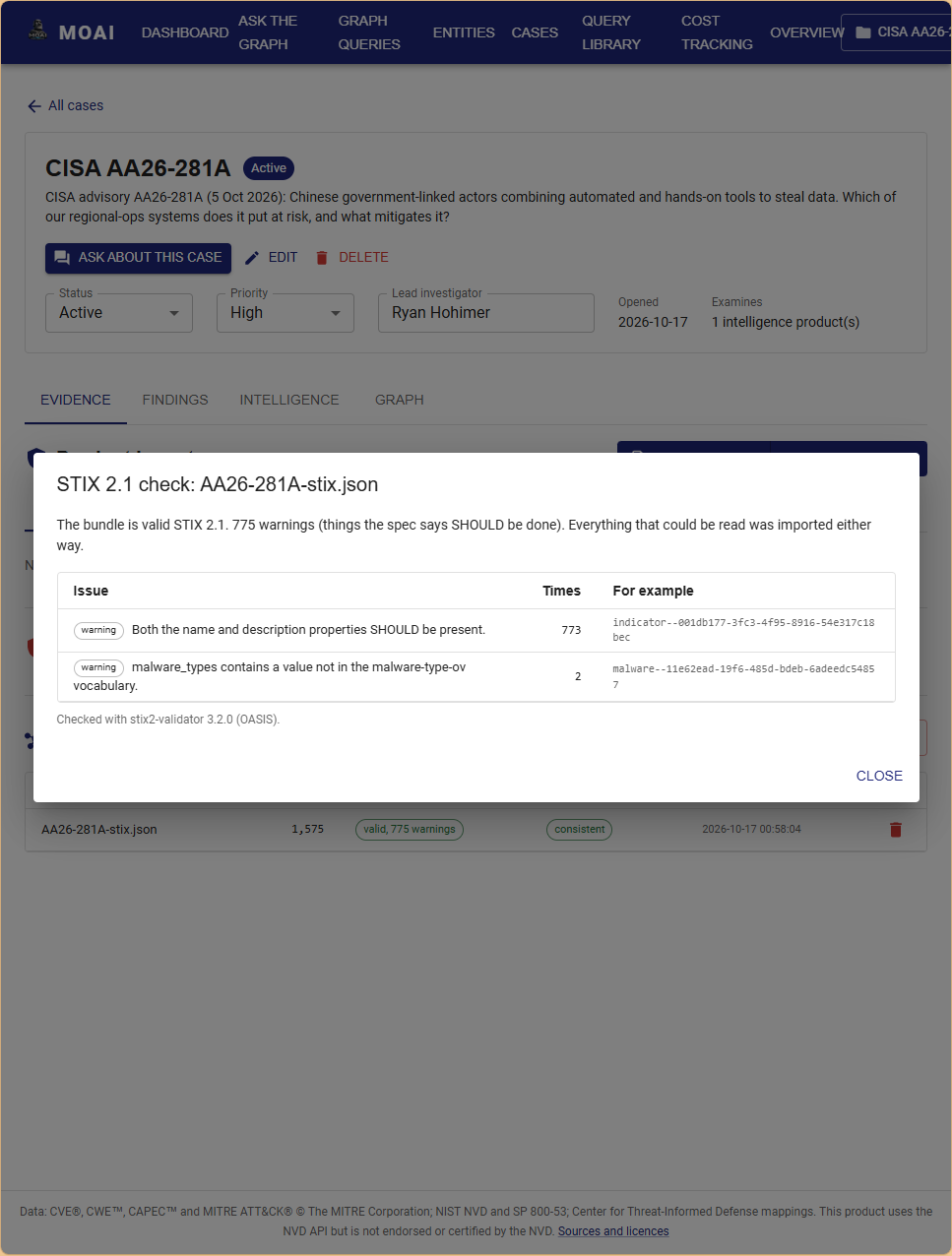
Neither check blocks the import. I’ve seen plenty of invalid STIX that carries valuable intelligence. The reports tell the analyst what they’re working with.
3. Connect the advisory to the Encyclopedia
Here’s the trap: valid STIX can still connect to nothing.
CISA’s file names the ATT&CK techniques the actors used, but only inside each object’s name: “Collection / Archive Collected Data [T1560] (ENT)”. There’s no structured reference to ATT&CK. The CVEs are the same: the ID is in the name and nowhere else. To a machine, the advisory’s “T1560” and ATT&CK’s T1560 are two unrelated things.
So Moai looks for these connections and proposes them, with how it found each one and a confidence:
- a structured external reference: 90;
- the ID as the whole name: 75;
- the ID embedded in a longer name: 60;
- a name match only: 50.
For AA26-281A it proposed 35 links.
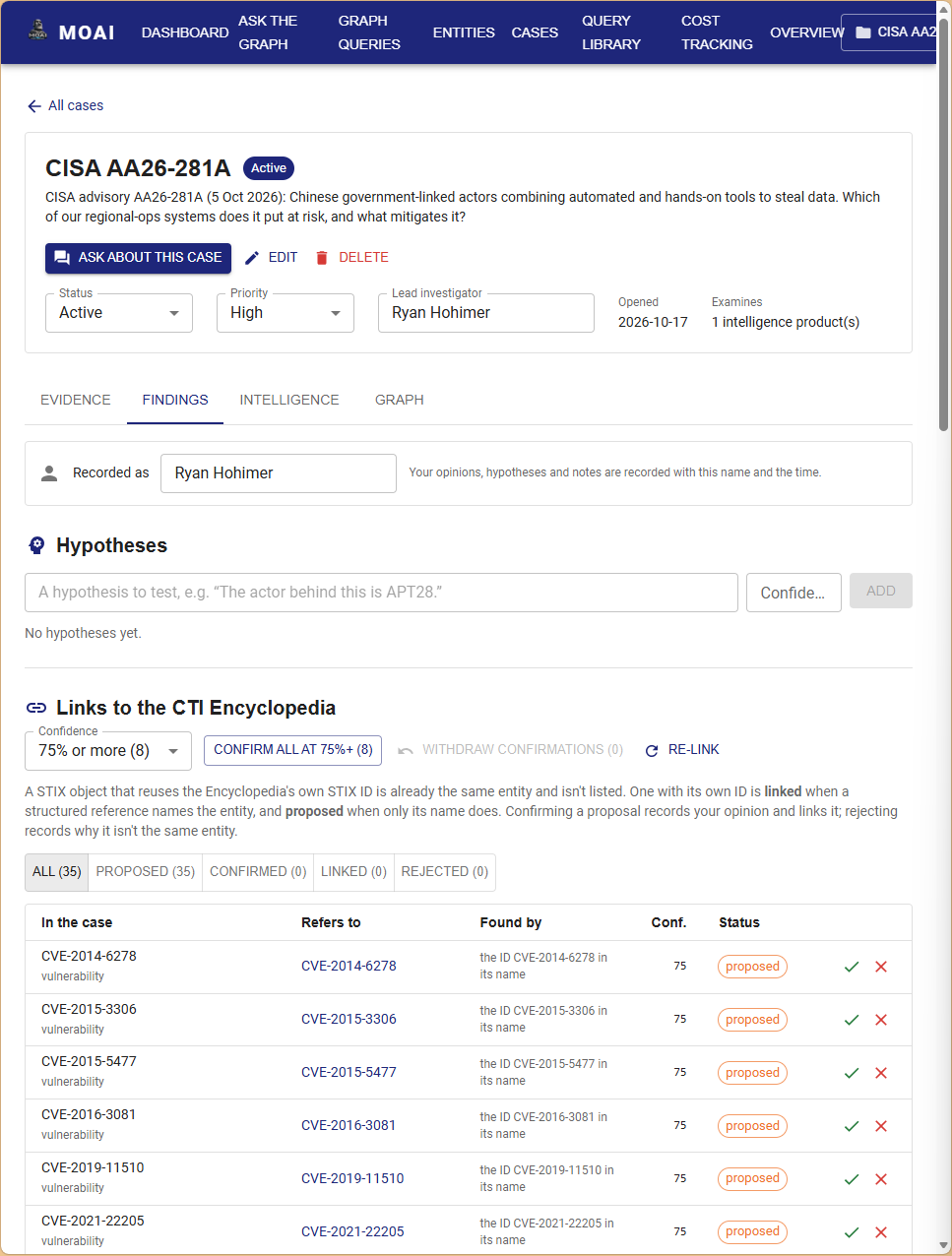
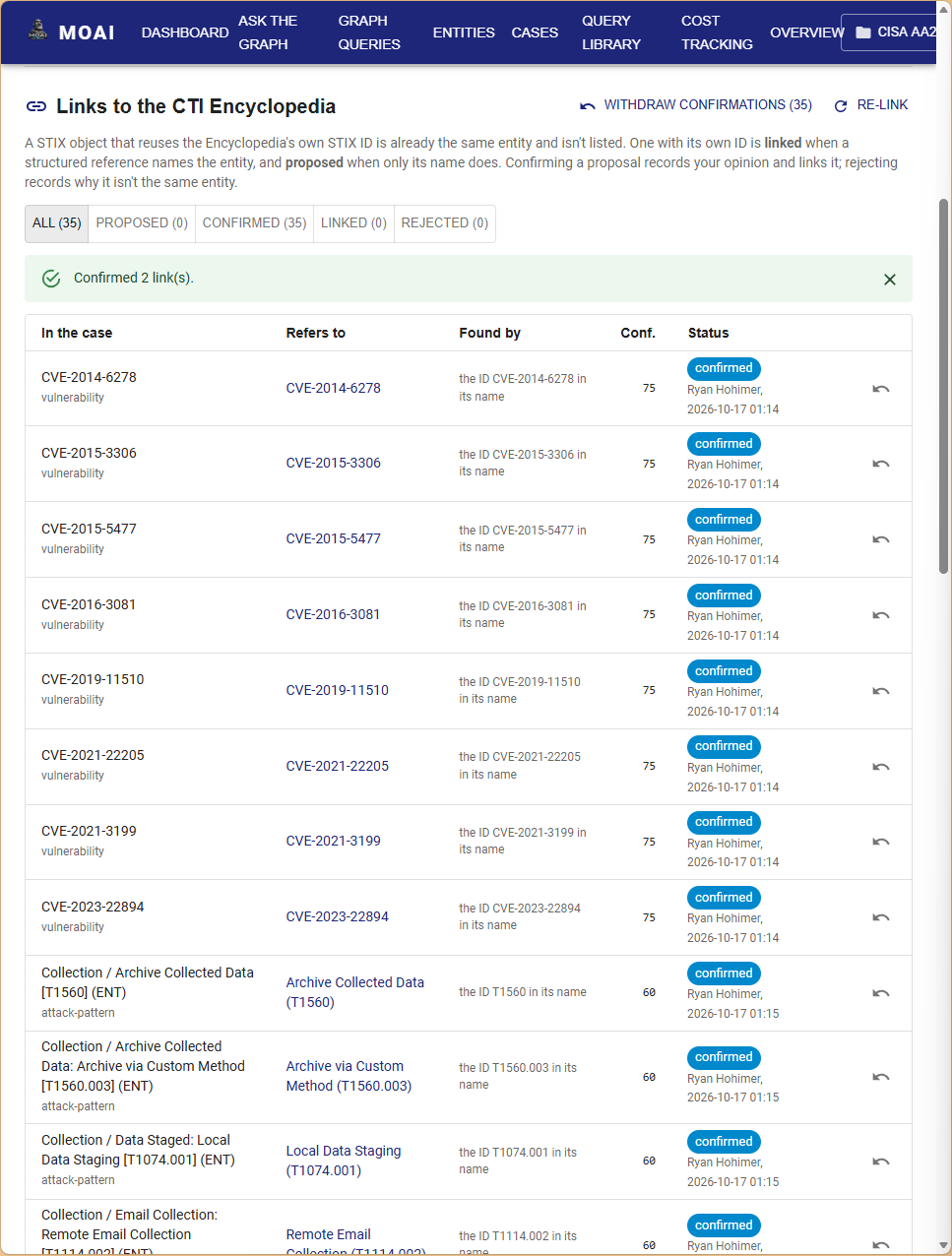
Moai proposes; the analyst decides. You can confirm everything above a confidence level in one click, then go through the rest. A confirmation isn’t a silent merge. It’s recorded as a stonework:Opinion, an analyst’s judgment, with their name and the time. You can reject a link, and the rejection records why it isn’t the same thing. You can also withdraw any of it later.
4. Add the inventory
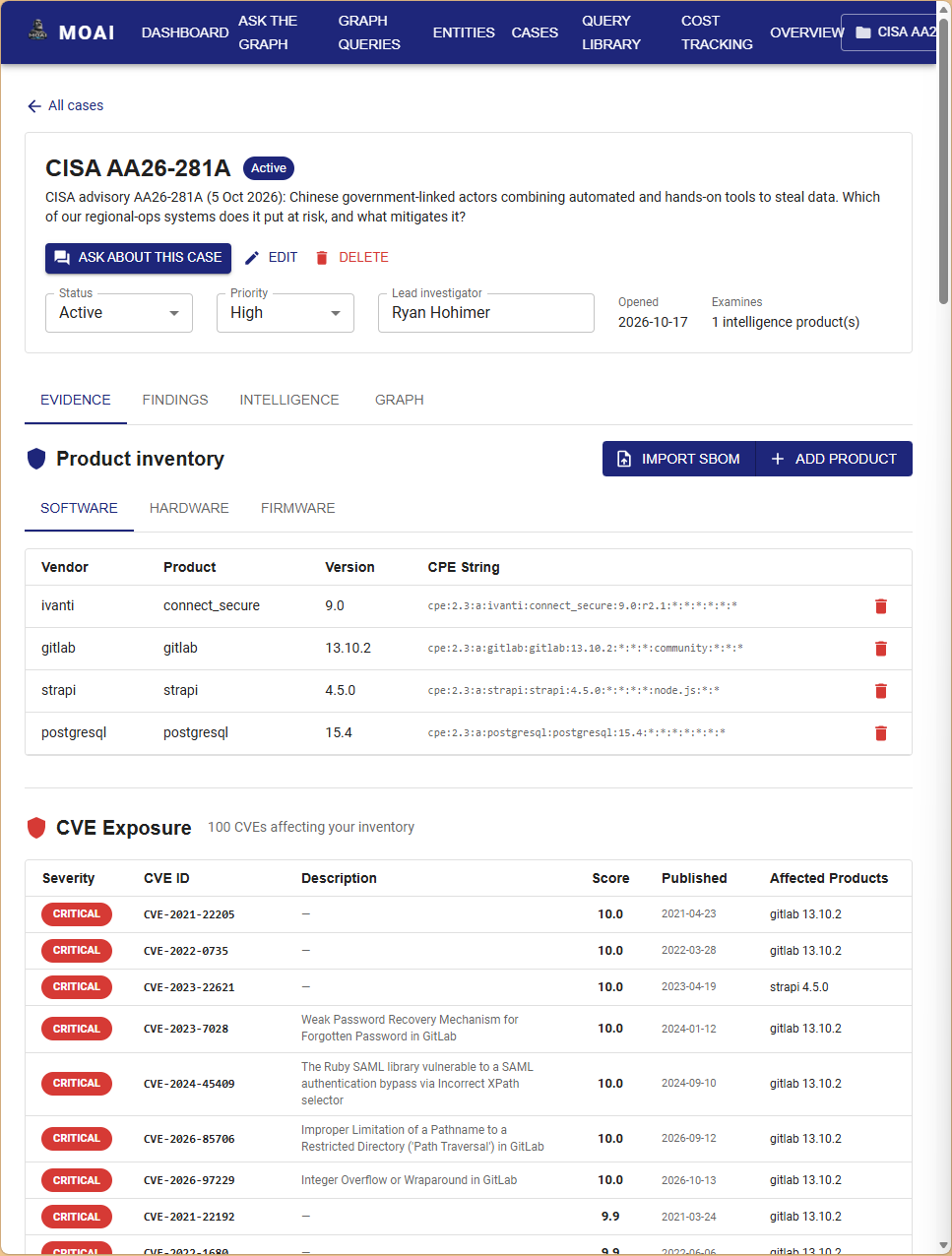
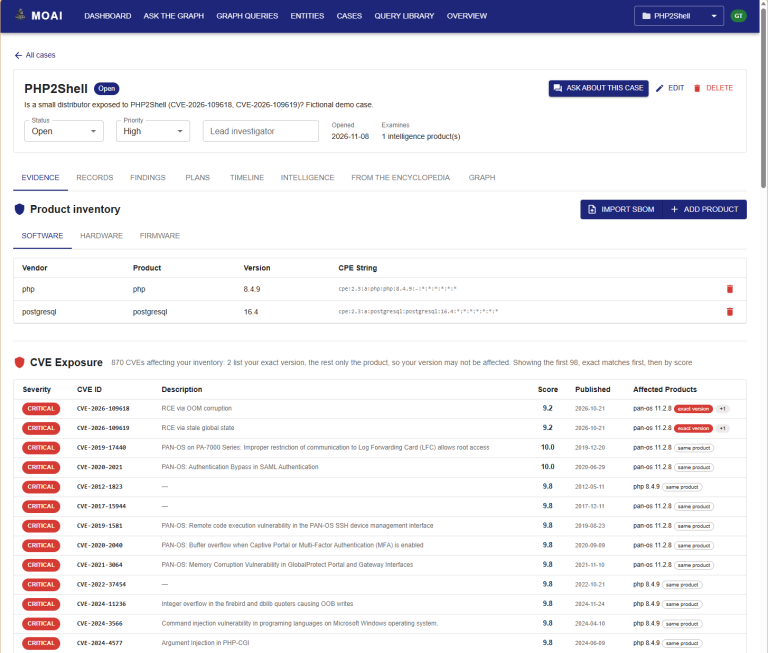
Matched against the Encyclopedia, four products bring in about 1,700 known CVEs, seven of them scored a perfect 10.0. The Evidence tab shows the worst hundred.
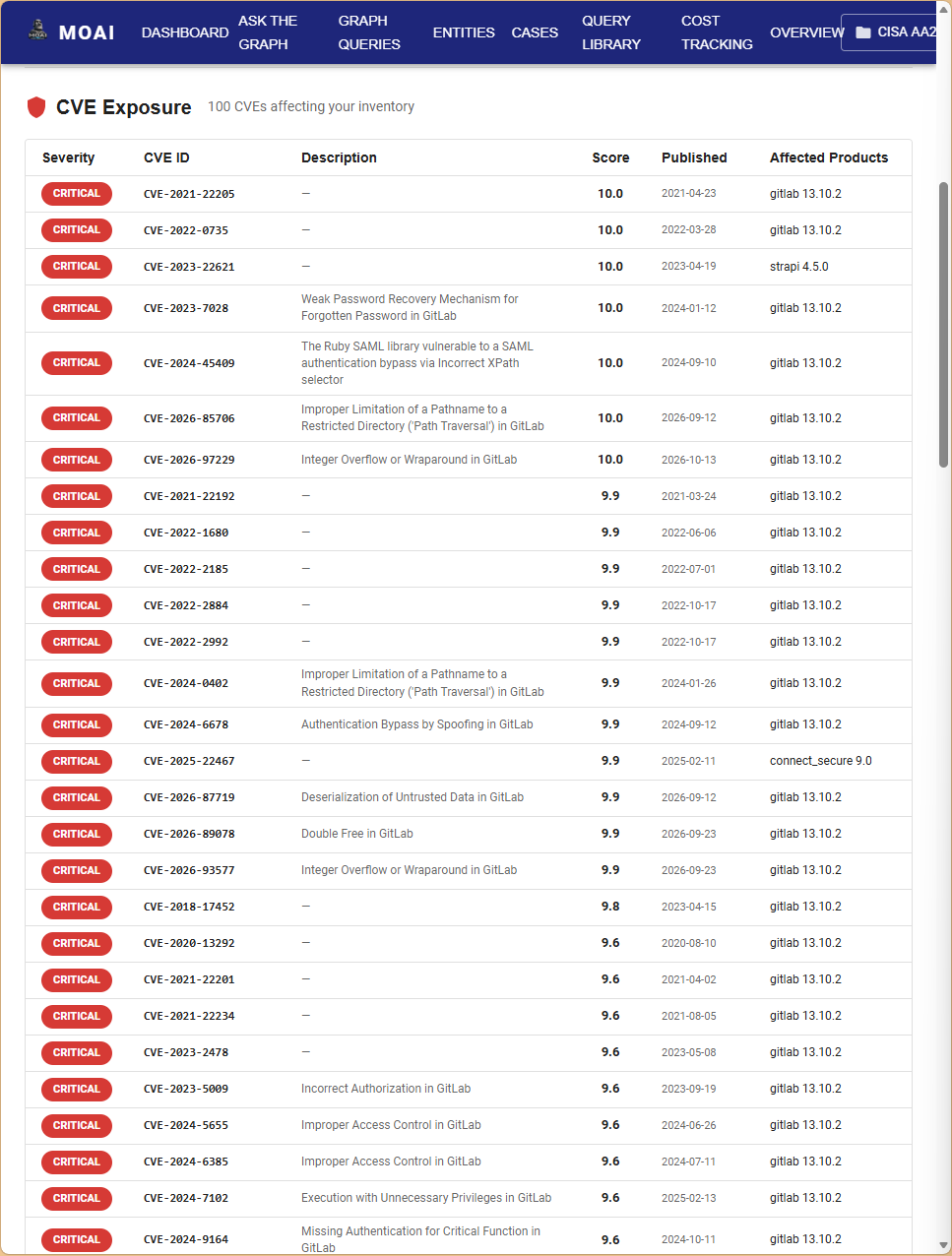
Sorting by CVSS doesn’t tell you what this advisory makes urgent. That’s the next tab.
5. What the Encyclopedia adds
The Intelligence tab follows the analyst’s confirmed links into the Encyclopedia. It shows what the Encyclopedia knows that the advisory doesn’t say.
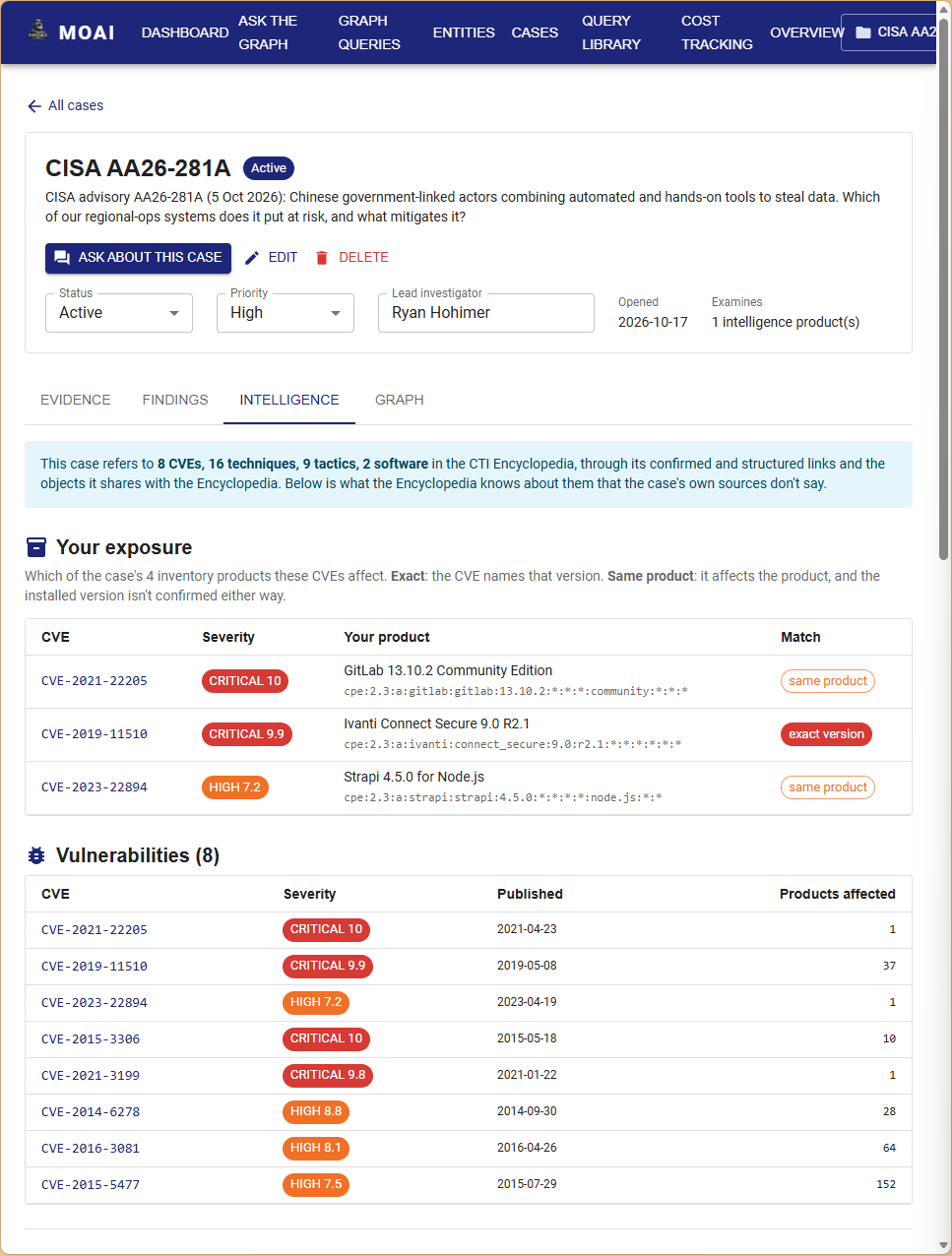
Your exposure. Out of roughly 1,700 CVEs, three matter for this advisory, and each comes with the reason:
| CVE | Severity | Your product | Match |
|---|---|---|---|
| CVE-2021-22205 | Critical 10.0 | GitLab 13.10.2 Community Edition | same product |
| CVE-2019-11510 | Critical 9.9 | Ivanti Connect Secure 9.0 R2.1 | exact version |
| CVE-2023-22894 | High 7.2 | Strapi 4.5.0 for Node.js | same product |
“Exact version” means the CVE record names the version you run. “Same product” means it affects the product, and the record doesn’t settle your version either way, so check it.
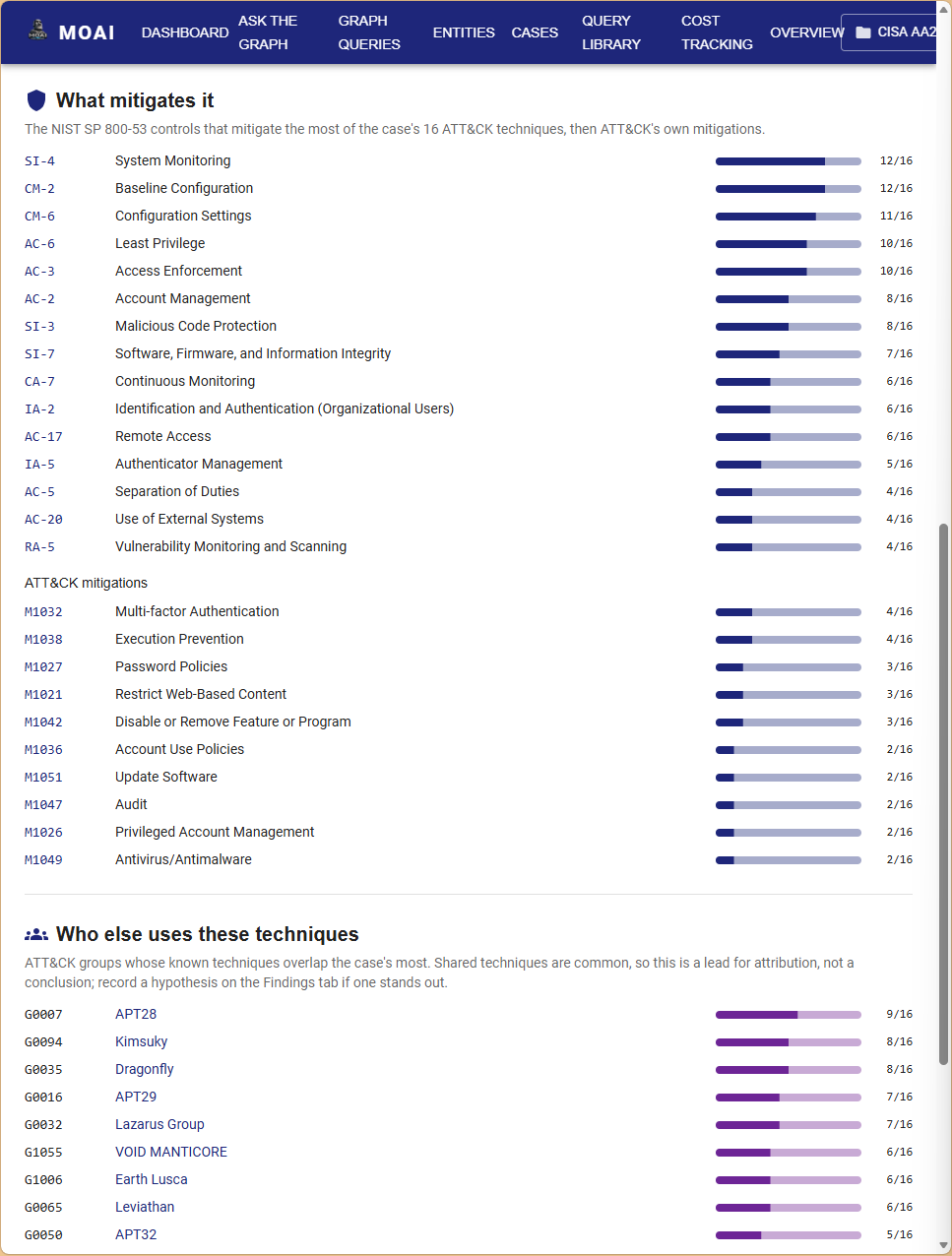
What mitigates it. Which NIST SP 800-53 controls mitigate the most of the advisory’s 16 techniques: SI-4 System Monitoring and CM-2 Baseline Configuration cover 12 each, and CM-6 Configuration Settings covers 11. Then ATT&CK’s own mitigations, led by multi-factor authentication. None of this is in the advisory.
Who else uses these techniques. CISA attributes the activity to Flax Typhoon. The Encyclopedia shows which known ATT&CK groups use the most of the same techniques: APT28 9 of 16, Kimsuky and Dragonfly 8 each. Shared techniques are common, so this is a lead, not an attribution.
6. Record the reasoning
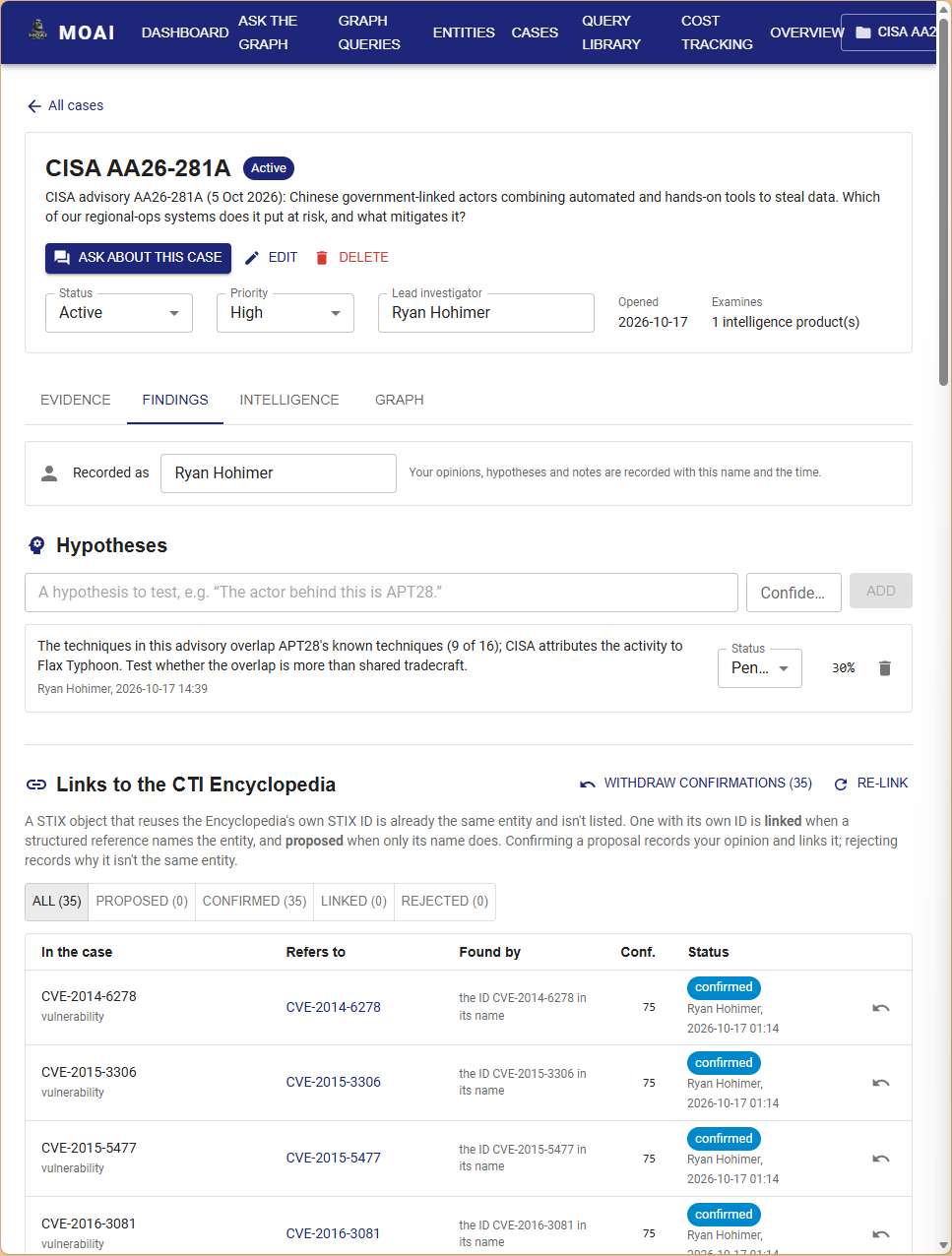
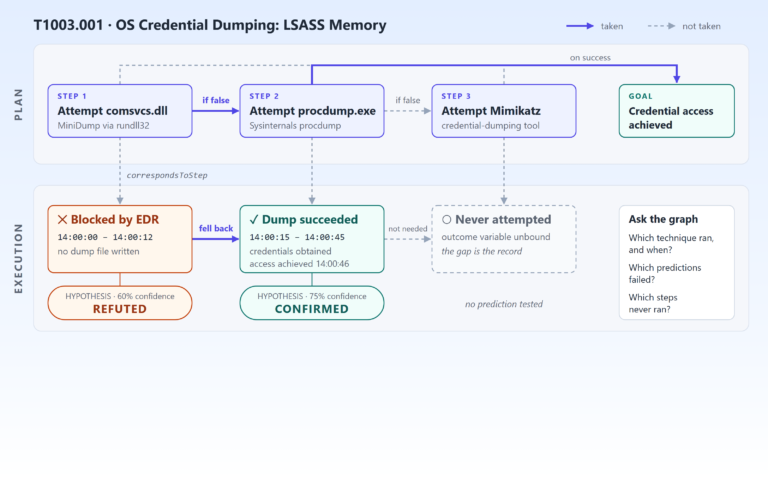
The analyst’s thinking belongs in the case, not in a chat window or a separate document. Hypotheses carry a status and a confidence. Notes carry an author and a time. Both are stonework facts, so they stay with the case, and so does the evidence they rest on.
7. Ask the question
Everything so far has been clicks. The graph speaks SPARQL, but the analyst doesn’t have to: Ask the Graph takes the question in plain English, and the assistant writes and runs the queries itself. Because it’s asked from the case, the case’s confirmed links tell it exactly which Encyclopedia entities the question is about.

It takes a few minutes, with Moai showing the assistant’s progress as it works. The SPARQL it wrote is kept with the answer, for anyone who wants to check it.
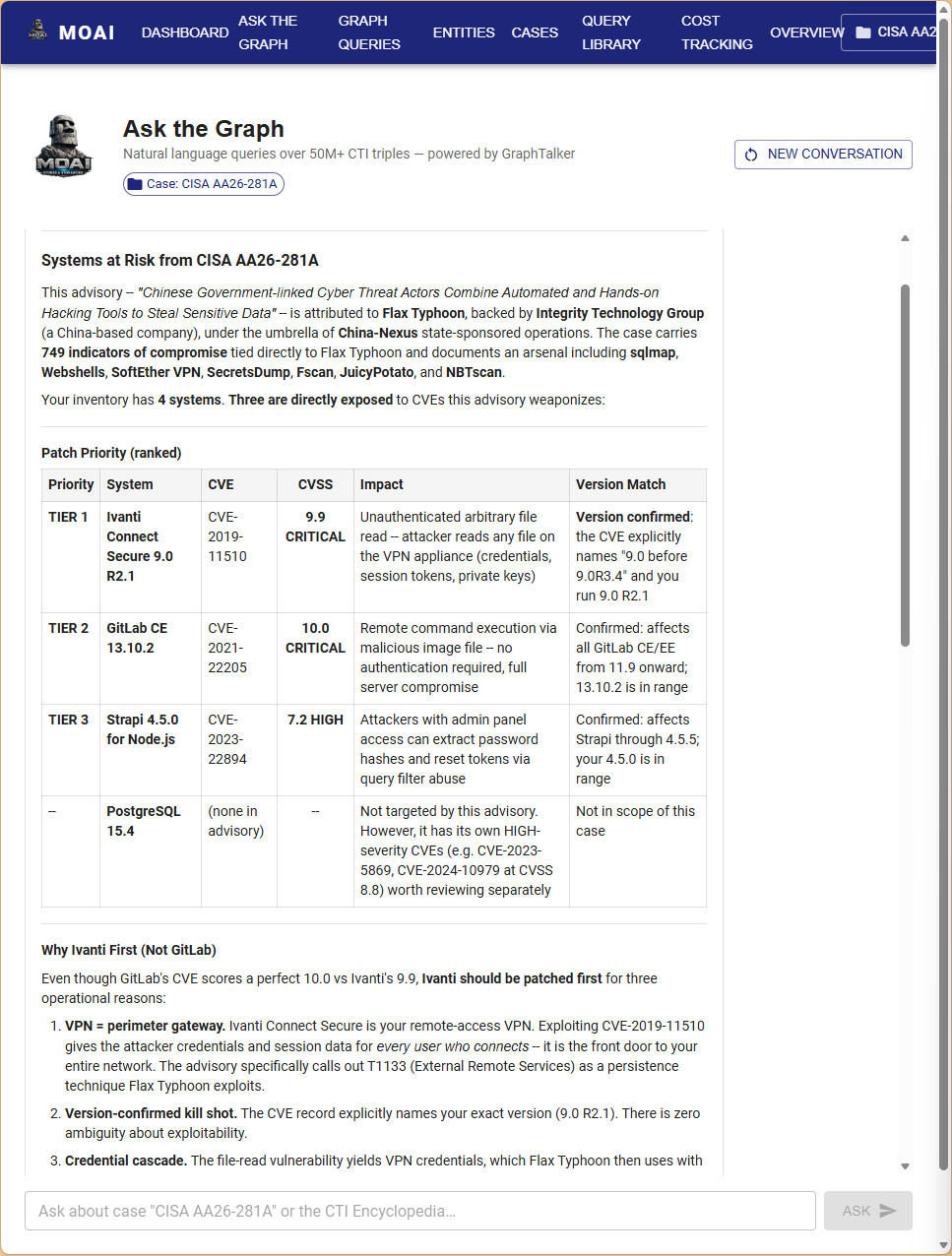
The answer is the most interesting part of the demo. It ranked Ivanti first, ahead of GitLab, even though GitLab’s CVE scores higher (10.0 vs 9.9). Its reasons:
- the Ivanti appliance is the remote-access VPN, the perimeter;
- the CVE names the exact version you run;
- the flaw is an unauthenticated file read that gives up VPN credentials and session data, the starting point for the credential theft and lateral movement the advisory describes.
GitLab comes a close second (“if it’s internet-facing, treat it as co-equal”), then Strapi, whose flaw needs admin access first. PostgreSQL isn’t touched by this advisory.
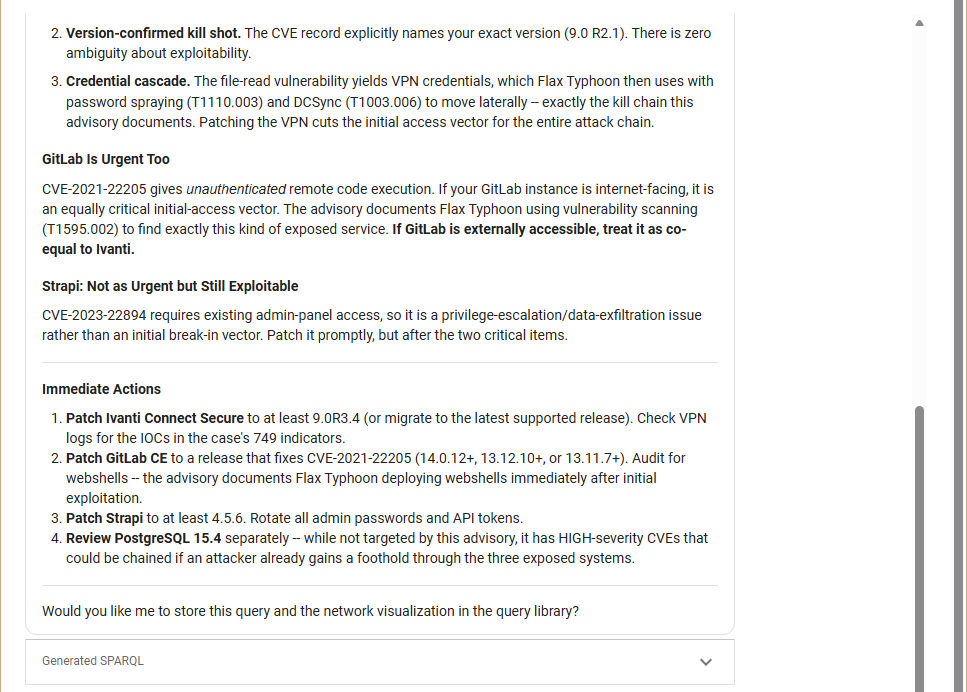
That ranking is judgment, and it’s the kind of judgment a CVSS sort can’t give you.
A word on what’s computed and what isn’t. Everything on the Intelligence tab is computed: graph queries over the case and the Encyclopedia, with the same answer every time. The ranking and its reasoning come from a large language model (Claude, through GraphTalker), working from the same graph. It’s very good, and it can still be wrong, so treat it as a capable colleague’s draft and check it against the evidence. That’s easy here, because the evidence is one click away. When I checked this answer, I thought I’d caught it out: it says the case carries 749 indicators, and the file has 773. It was right. 749 of them indicate Flax Typhoon, which is exactly what it said; the other 24 point at tools like JuicyPotato and SoftEther.
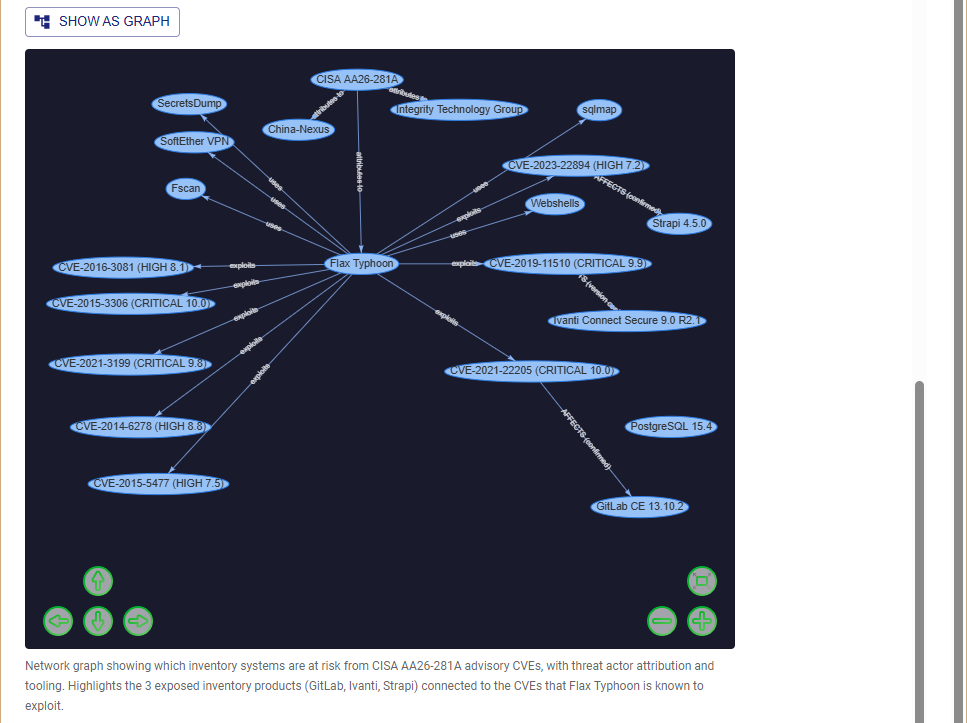
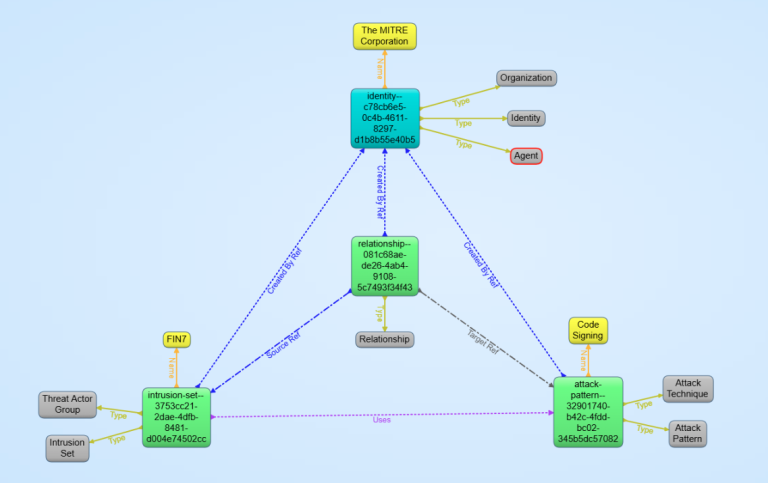
8. The case, as a graph
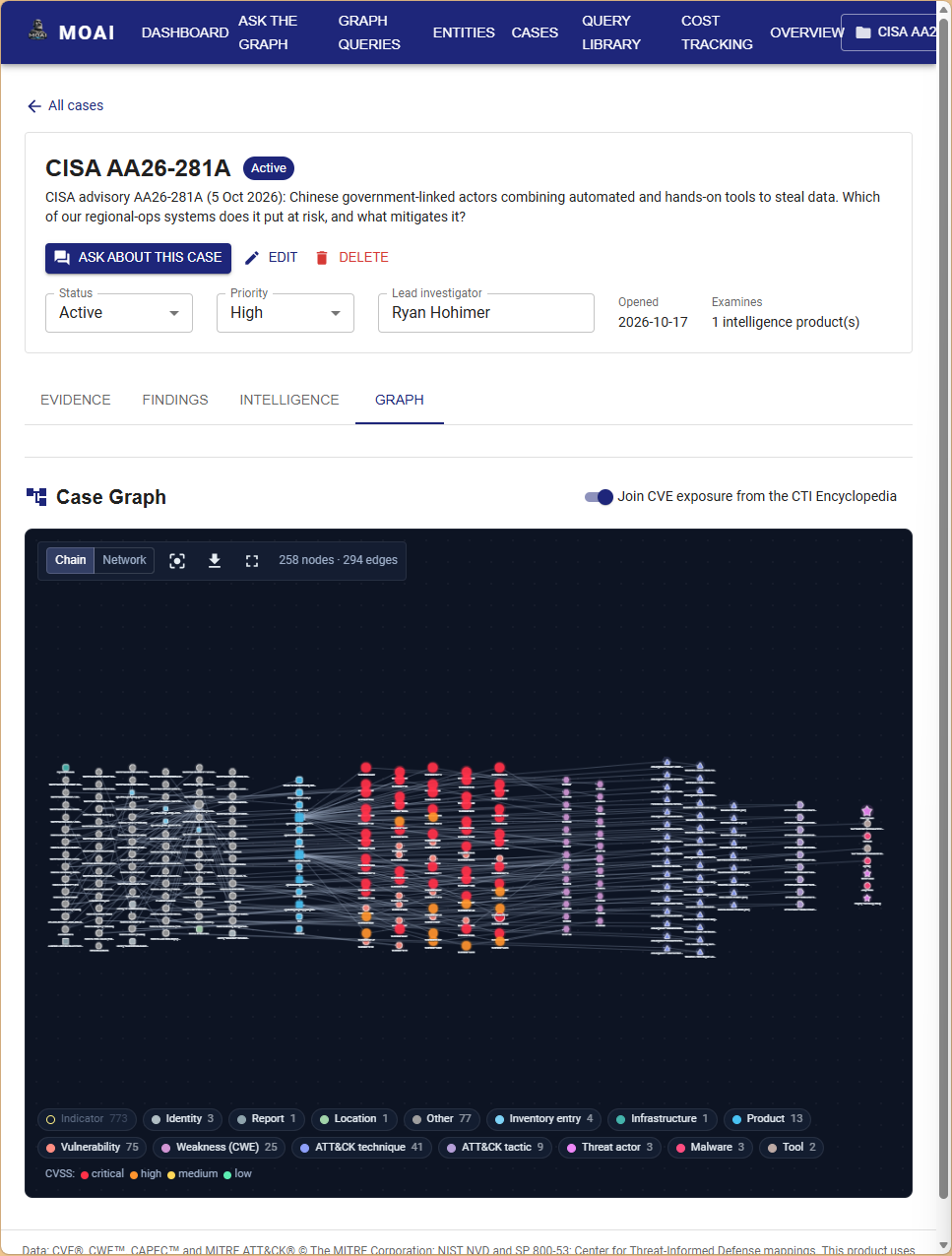
Everything above is one graph: the advisory, the analyst’s opinions of each link, the inventory, the hypotheses and notes, and the Encyclopedia facts they connect to. Nothing was copied out into a report to get here, and nothing has to be copied back.
Where this is going
Moai is heading to its first release candidate. The CTI Encyclopedia and STONEWORK are where most of the work has gone, and STONEWORK is open: the 0.11.0 release added the investigation concepts this demo uses.
If you work with threat intelligence and want to see where this goes, follow along here on cyberterrain.org. STONEWORK is on GitHub at github.com/Cyber-Terrain-Ontology/stonework, and the ontology itself is published at cyberterrain.org/ns/stonework.html.
The inventory in this demo is made up. The advisory, its STIX file, and the Encyclopedia data are real. CVE®, CWE™, CAPEC™ and MITRE ATT&CK® © The MITRE Corporation; NIST NVD and SP 800-53.