“Do We Run PHP?” Is the Wrong Question
On 21 October, PHP’s developers shipped emergency fixes for two flaws that let anyone on the internet run code on a web server, without logging in. Researchers named them PHP2Shell (CVE-2026-109618 and CVE-2026-109619). CISA told organizations to patch immediately, or take PHP systems offline until they could. Some governments and large companies did just that, and pulled websites down. Five days later CISA confirmed that attackers were exploiting both flaws and gave federal agencies three days to patch.
If you run a small or mid-sized organization, the first question you probably asked was: do we run PHP?
It’s a reasonable question, and it’s the wrong one.
PHP is inside things
PHP runs on about 70 percent of web servers. You’d expect it under WordPress, under a customer portal, under the web shop a contractor built five years ago. Those you can probably find.
What’s harder to find is PHP inside products you bought. CISA’s alert says it plainly: PHP “is often embedded in other software” and may not be easy to identify. Vendors build it into appliances, management consoles and industrial systems. You never installed it. It isn’t on any list of software you run. It came with the box.
So the useful question isn’t “do we run PHP?” It’s: which of the things we own are affected?
What the record says
Every published vulnerability has a record listing the products it affects. For PHP2Shell, those records list close to 300 affected products and versions each. A handful of entries are PHP itself. Most are Palo Alto Networks PAN-OS, the operating system of Palo Alto’s firewalls: 286 versions. Panorama, Palo Alto’s management system, is there too, along with several Siemens product lines.
A firewall is about the last place you’d go looking for a PHP flaw. It’s also one of the first places you’d want to know about one, and Palo Alto’s own Unit 42 has reported attacks on PAN-OS management interfaces.
A small distributor’s afternoon
To see what this looks like in practice, we built a made-up case in Moai: a small distributor, reading CISA’s alert on the day it came out.
The distributor’s IT lead keeps a short inventory of what runs on the network, the kind of list an insurer’s questionnaire asks for:
- the edge firewall, a Palo Alto running PAN-OS 11.2.8;
- PHP 8.4.9, under the online order portal;
- PostgreSQL 16.4, the portal’s database.
Nothing on that list says the firewall runs PHP.
The security team writes up its notes on the alert: the two CVEs, and the techniques an attacker would likely use after getting in, which are exploiting a public-facing application, and leaving a web shell behind to come back through. They bring the notes and the inventory into a new Moai case.
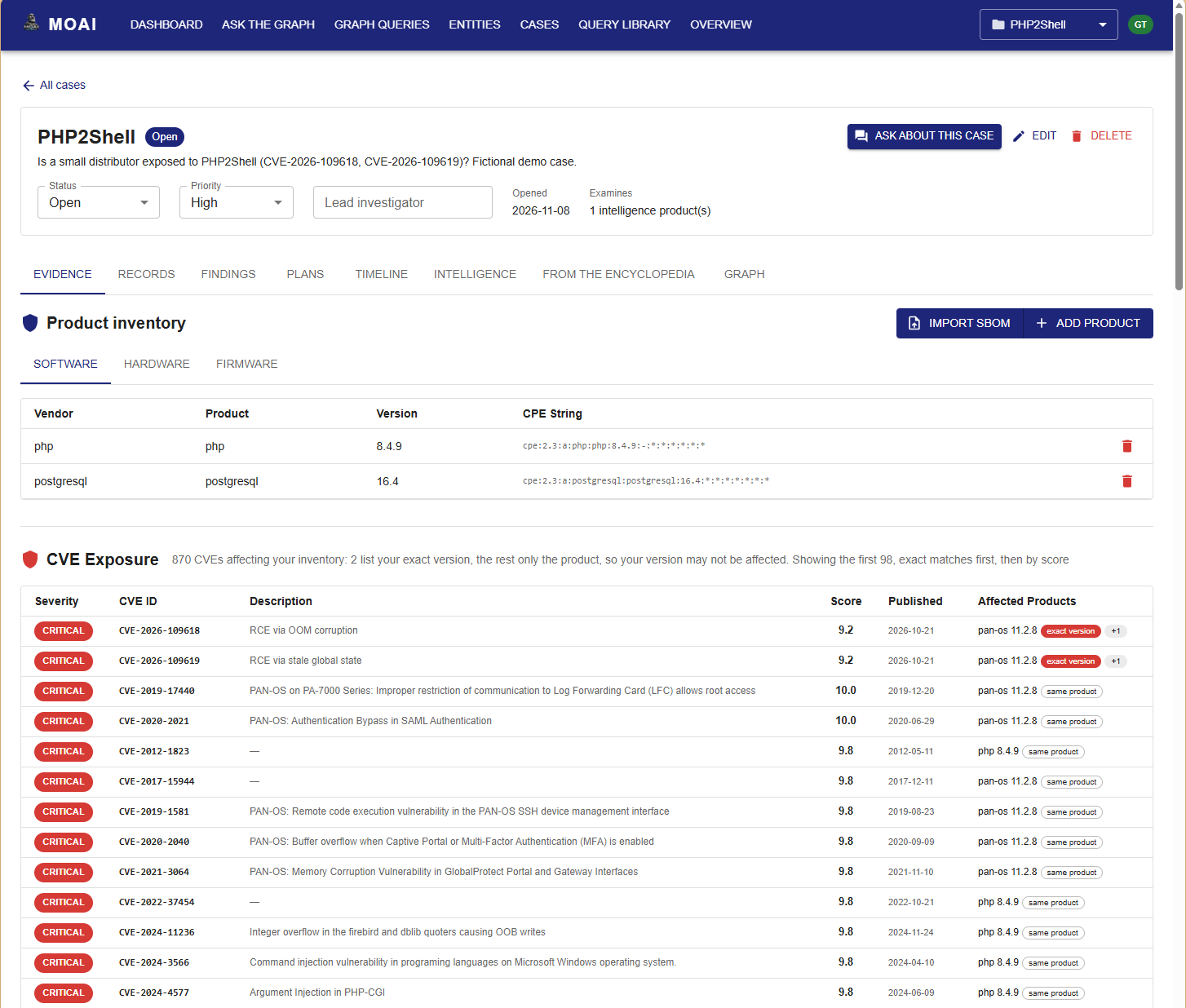
The first answer is the firewall. Both PHP2Shell CVEs come up as exact matches on PAN-OS 11.2.8: that version is listed by name as affected. That’s the one to act on today, and it’s the one the team wouldn’t have found by searching for PHP.
The second is the portal. PHP 8.4.9 shows as a same product match. The record names PHP as affected and says which versions fix it, so the team checks the version against the fixed releases (8.4.27 for the 8.4 line) and puts the portal’s PHP upgrade on the list.
The third is the database: PHP2Shell doesn’t touch it. Knowing what isn’t affected matters too. It’s the part of the afternoon nobody has to spend.
The difference between an exact match and a same-product match is worth a moment. Many vulnerability lists match on product name alone, so every CVE ever filed against PHP shows up against any PHP you run, including ones fixed a decade ago. That buries the two that matter under dozens that don’t. Moai puts the exact-version matches first and labels every match with which kind it is, so the team starts with what the record says about their version.
What to do about it, and what to watch for
Patching is the fix, and the only complete one. But a small team also needs to know what to do while it patches, and what an attack would look like if one had already happened.
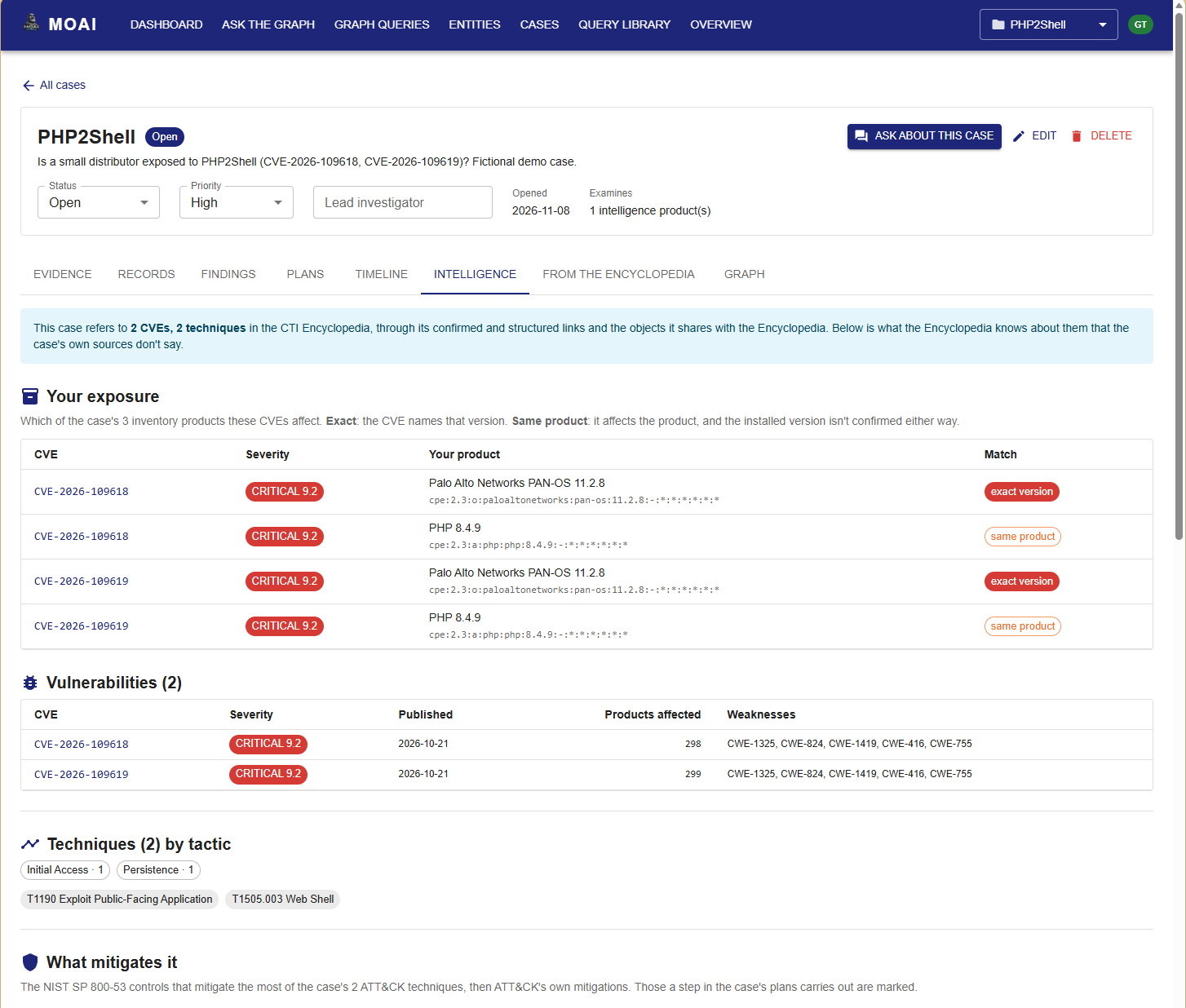
Moai’s Intelligence view draws that from the CTI Encyclopedia, the shared body of security knowledge Moai is built on. For the two techniques in the team’s notes, it shows the controls that mitigate them:
- System monitoring (NIST SP 800-53 SI-4) covers both: watch the web servers.
- Limiting access to resources over the network (MITRE ATT&CK mitigation M1035) is the one that matters most for the firewall: a management interface that can’t be reached from the internet can’t be exploited from it.
The FBI’s notice on PHP2Shell says what to watch for: PHP processes unexpectedly starting command shells or downloading files. If you find that, isolate the system, preserve the web server and PHP logs, and report it to your local FBI field office or IC3.
That last step is the beginning of a different question: not “are we exposed?” but “we were hit; what can we show happened?” That’s an investigation, with its own demands on evidence, and it’s the subject of a future post.
The point
PHP2Shell will be patched and forgotten, like the flaws before it. The pattern won’t: a component everyone uses, inside products nobody thinks of as containing it. The organizations that get through these weeks well aren’t the ones that know every component in every box. They keep an honest list of what they own, and they can turn an alert into “these are ours, this one first” in an afternoon.
That’s what Moai is for.
Moai isn’t publicly released yet. If you’re responsible for security at a small or mid-sized organization, or you serve those that are, we’d like to hear from you. Leave your email under Stay Updated on our Built on STONEWORK page and tick MOAI, and we’ll let you know when it’s available.
Moai is being built by Hohimer Intelligence Strategies LLC on the STONES and STONEWORK ontologies, which are open and published at cyberterrain.org/ns by the Cyber Terrain Ontology project.
Sources: CISA, Critical Vulnerabilities in PHP Require Immediate Patching (21 October 2026, revised 26 October); FBI, IC3 PSA 261023; TechCrunch, US government says hackers are now exploiting critical PHP web bugs (27 October 2026); Palo Alto Networks Unit 42, Threat Brief: CVE-2026-109618, CVE-2026-109619. The case in this post is fictional.