Business Processes Are Crown Jewels
Ask a security team to name its crown jewels and you’ll hear about databases, source code, customer records and the domain controller. Those matter. But some of the most valuable things an organization owns aren’t stored anywhere. They’re the way it does its work: how it pays a supplier, approves a refund, onboards an employee, resets a password, releases a shipment.
Business processes are crown jewels. Attackers know it, and increasingly they don’t break into systems so much as walk through processes, one ordinary-looking step at a time.
Our security tools mostly can’t see that.
Three ways of looking
Today’s security monitoring sees the world in roughly three ways.
Infrastructure-centric. A SIEM collects events from hosts, networks, identity providers and cloud services, and correlates them. It is very good at answering “what happened on this system?” It knows about sign-ins, processes and connections.
Behavior-aware. User and entity behavior analytics (UEBA) learns what’s normal for each user and device, and alerts when something departs from it: a sign-in from a new country, a download far larger than usual. It knows about people’s habits.
Process-aware. This is the missing view. It knows how the organization’s work is supposed to go: which steps, in what order, by which roles, under which controls. And it checks what actually happened against that.
Infrastructure tells you what the systems did. Behavior tells you whether a person acted like themselves. Neither tells you whether the business followed its own rules. That is the question auditors, insurers and, after a loss, law enforcement will ask. With Moai, the analyst platform Hohimer Intelligence Strategies LLC is building on STONEWORK, it’s now a question you can answer.
An attack where nothing looks wrong
Consider a business email compromise. In 2025, victims reported more than $3 billion in BEC losses to the FBI’s Internet Crime Complaint Center, second only to investment fraud (2025 IC3 Annual Report). Our worked example follows a fictional manufacturer.
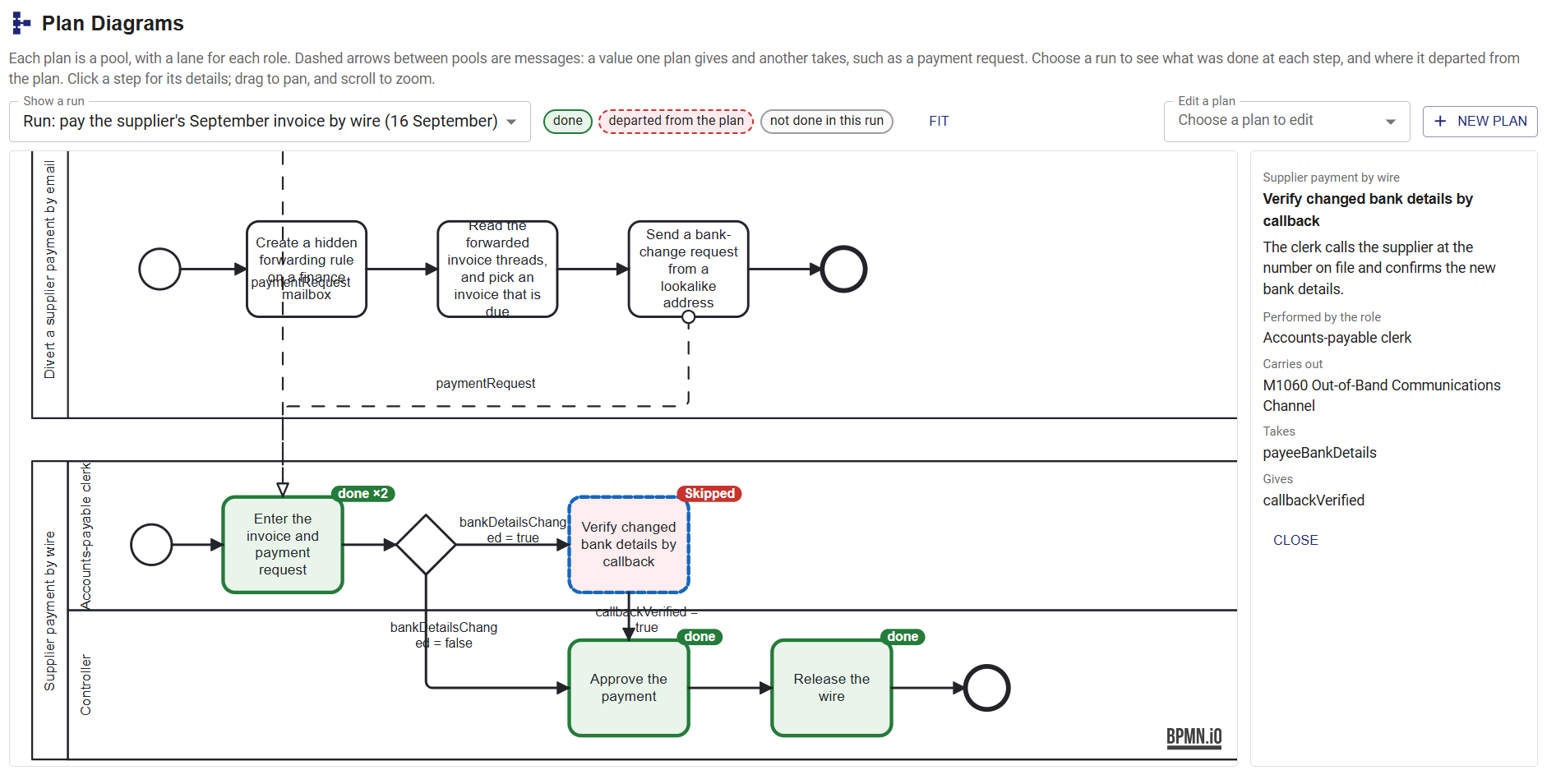
An attacker gains access to the controller’s mailbox and quietly creates a hidden inbox rule that forwards finance mail to them. For two weeks they read along. Then, from a lookalike domain one character off from a real supplier’s, they send the accounts-payable clerk a convincing note: our bank details have changed; please pay invoice 44871 to this new account. The clerk enters the payment. The controller approves it. The wire goes out to a mule account.
Now look at it the way our tools do. The sign-ins used valid credentials. The inbox rule was created by the account’s owner, as far as the logs know. The payment was entered, approved and released by the right people, in the bank’s own portal. Every individual event is unremarkable. There is no malware to find and no anomaly loud enough to page anyone.
What went wrong wasn’t a system. It was the process.
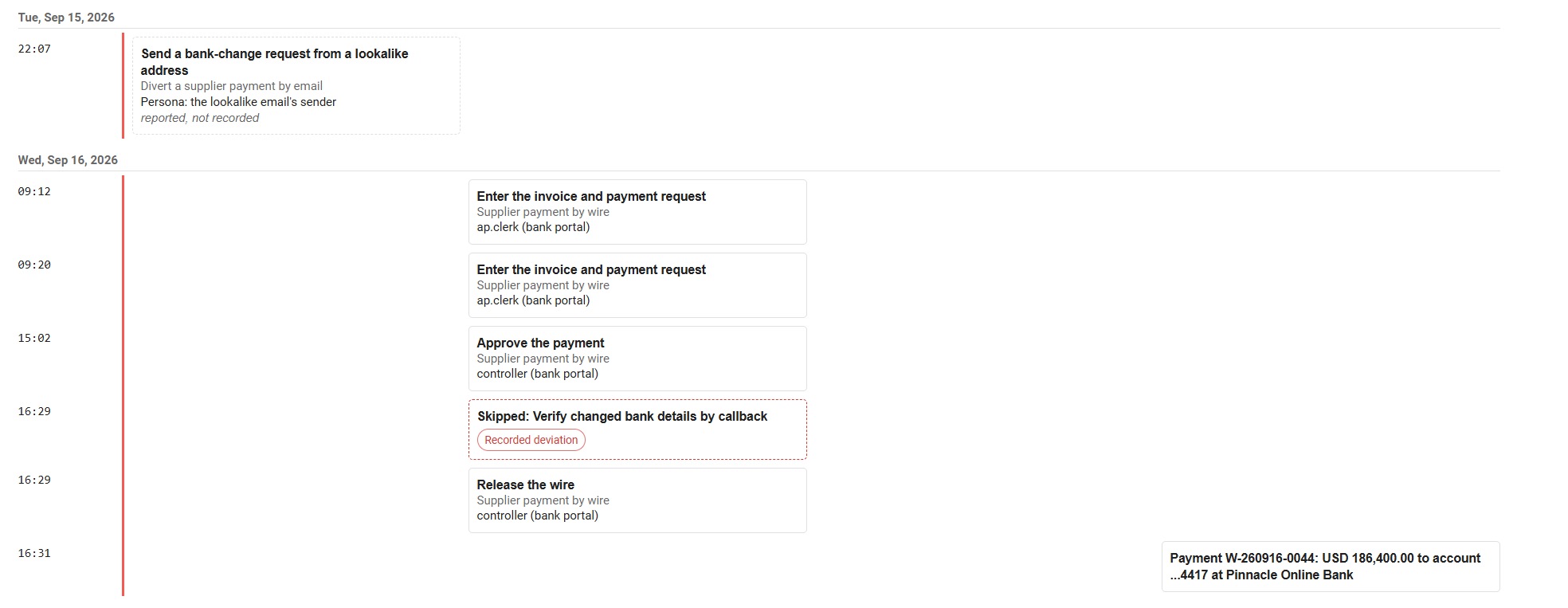
The manufacturer’s supplier-payment process says that when a payee’s bank details change, the clerk must call the supplier on a number already on file and verify the change before the payment goes to approval. On 16 September, that step never happened. The process went on without it.
And AI is making the forged request harder to spot: businesses reported over $30 million in 2025 losses to BEC scams that used it. A process-aware check doesn’t care how convincing the email is, only whether the callback happened.
What a process-aware tool says
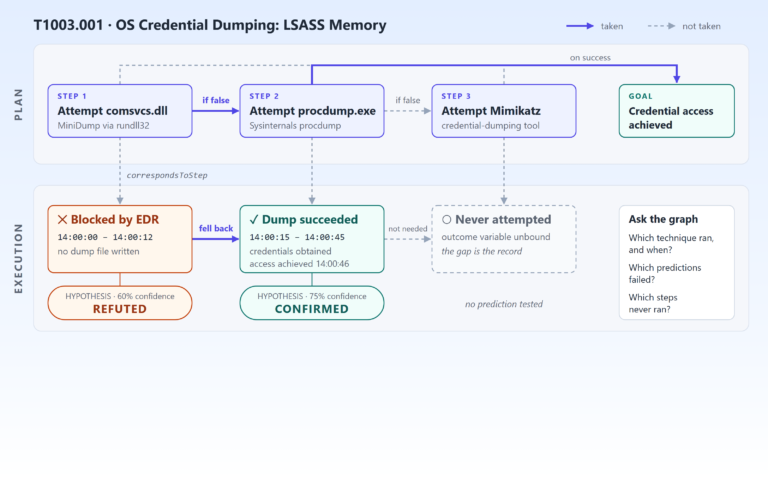
In Moai, the manufacturer’s supplier-payment process is a plan: its steps, the roles that perform them, the controls each step carries out, the values each step takes and produces, and the conditions on each path. An investigation places the evidence, the log records, the emails and the call records, into runs of that plan. Moai then checks each run against its plan.
For this case, Moai’s findings read like this:
- The 16 September payment went on without a required step. The bank details changed, so the callback was required, and the payment was approved and released anyway.
- The payment request came from the wrong party. The process expects the request from the supplier; this one came from the attacker’s step, sent from the lookalike address.
- On 30 September, the process worked. A second request arrived, the clerk made the callback, the supplier said nothing had changed, and the payment stopped there.
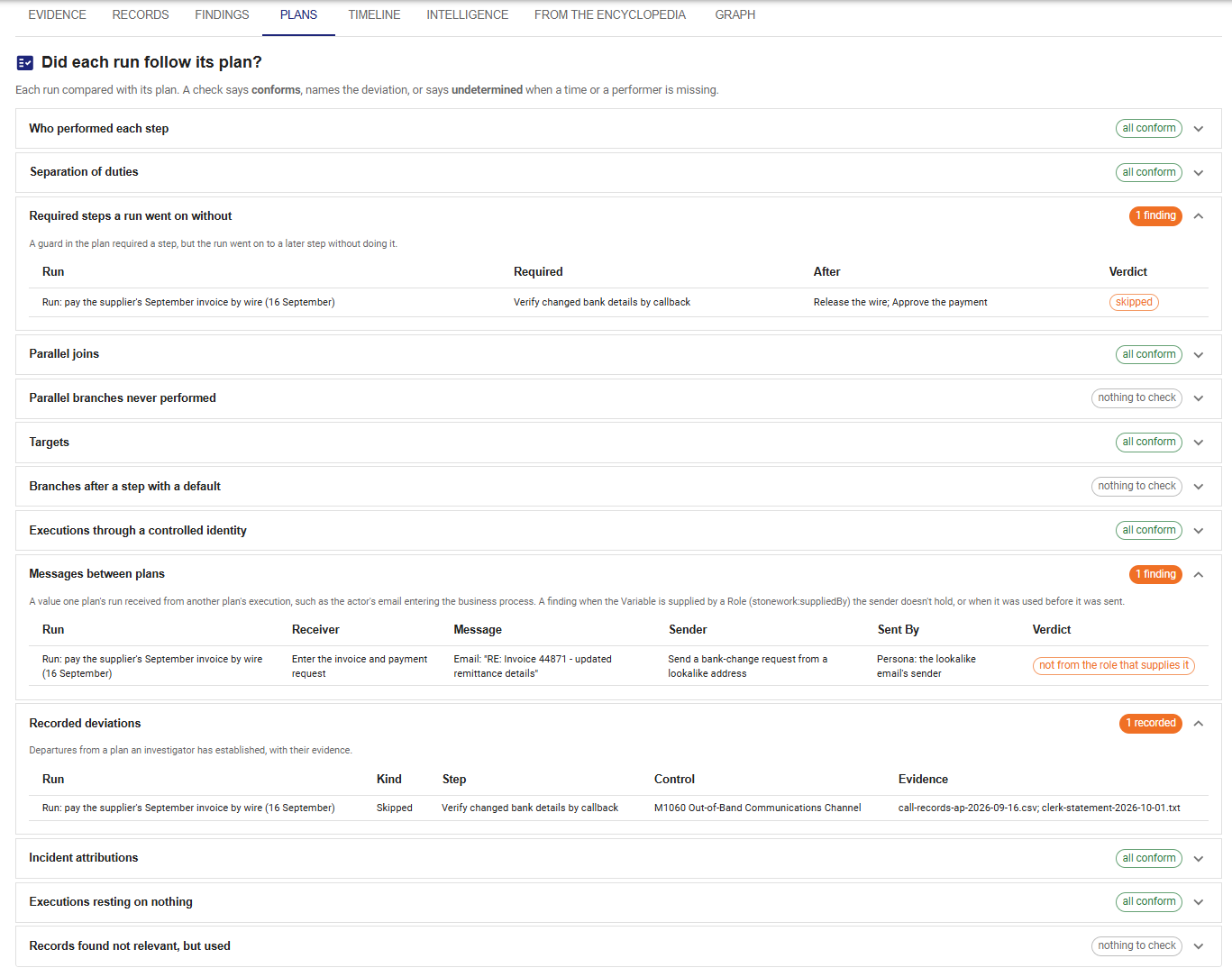
These aren’t risk scores. Each finding names the run, the step, the rule that was broken and the evidence that shows it: the call records with no call to the supplier that day, the clerk’s statement, the email and its headers. That is an explanation a CFO, an auditor or an investigator can follow, and check.
The attacker has a plan too
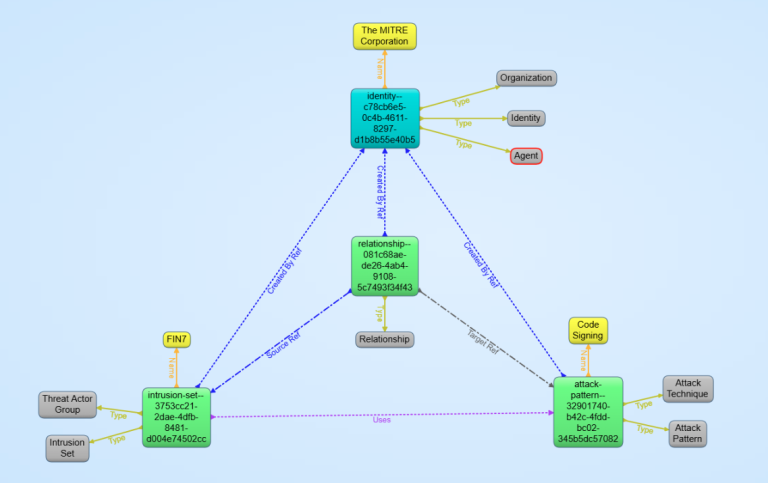
Here’s where it gets more interesting. Attackers also follow processes. They have procedures, carried out in order, each serving a goal. The security community already describes them this way, as tactics, techniques and procedures (TTPs).
So Moai represents the attacker’s operation as a plan as well, an attack plan: create a hidden forwarding rule on a finance mailbox (MITRE ATT&CK T1114.003, under Collection), then send a bank-change request from a lookalike address. As the investigation places evidence in it, the attacker’s run takes shape beside the manufacturer’s own.
And the two plans meet. The attacker’s output, a forged payment request, became an input to the manufacturer’s payment process. Seeing exactly where the attack plan plugged into the business process is the heart of understanding a BEC. It’s also where the next defense belongs.
Four kinds of process, one language
The business process and the attack plan are two of four kinds of plan Moai now understands:
- Business processes: the organization’s routine work, such as paying a supplier.
- Attack plans: the threat actor’s procedures, step by step, mapped to ATT&CK.
- Detection plans: how the organization looks for an attack, such as searching finance mailboxes for forwarding rules.
- Control plans: how it responds and contains, such as removing the rule, revoking the account’s sessions and blocking automatic forwarding.
What makes this powerful is that all four are expressed in one language: STONEWORK, our open ontology for cyber threat intelligence and the plans around it. Because they share a language, Moai can ask questions across them. Did the containment act on the account the detection found? Did the review wait for every containment step to finish? Which of ATT&CK’s mitigations for this technique do the organization’s own plans actually carry out, and which one did the business process skip?
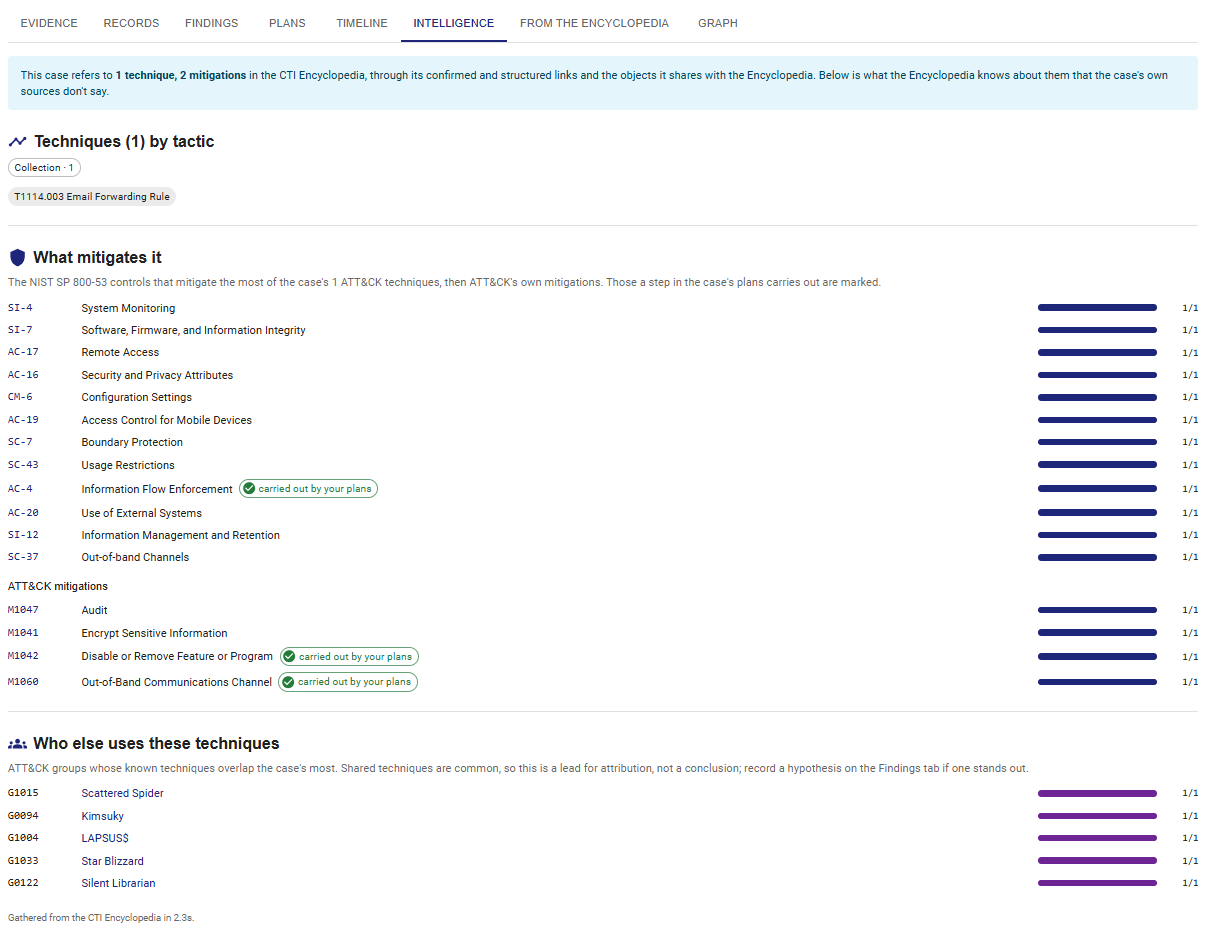
In our example, the manufacturer’s plans carry out two of ATT&CK’s four mitigations for T1114.003: blocking automatic forwarding, in the containment plan, and an out-of-band communications channel, the supplier callback. The second is the control that was skipped on 16 September. That one sentence connects a public technique, a recognized mitigation, the organization’s own process and a specific failure on a specific day.
Most tools model at most one of these kinds of process, if any. Modeling all four in one language is what turns separate records into a connected account of what happened.
Draw it the way you already know
None of this works if describing a process is a project in itself. So Moai’s plans are drawn in BPMN, the Business Process Model and Notation that business analysts already use: pools for each party, lanes for roles, tasks, gateways for decisions, and arrows with the conditions that choose a path. Draw the supplier-payment process the way it’s already drawn on a whiteboard, and Moai saves it as a plan it can check runs against.
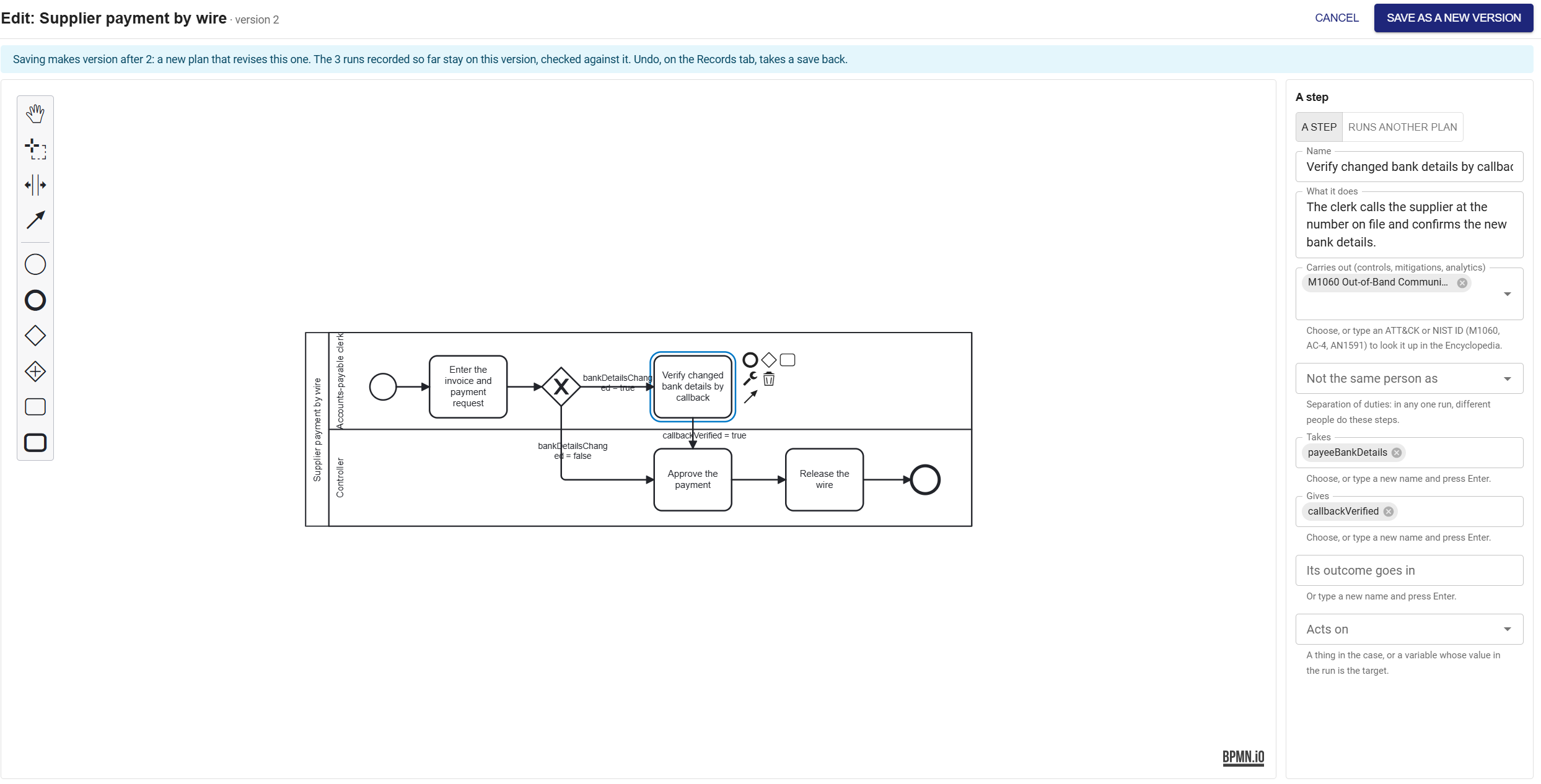
Plans are versioned. When a process changes, its old runs stay with the version they followed, so a finding about September is judged against September’s process.
We’ve also aligned STONEWORK’s plan model with OASIS CACAO, the open standard for security playbooks. For example, a step that runs another plan corresponds to CACAO’s playbook action. Exchanging playbooks with CACAO tools is on our roadmap.
Why this matters
Process awareness changes the questions an investigation can answer:
- Not just “was there an intrusion?” but “did our controls work?” The skipped callback is a control failure, with a date, a run and evidence. That’s what an audit committee or a cyber insurer needs to hear.
- Not just “what did the attacker do?” but “where did their plan meet ours?” That is where to put the next control.
- Not just “who signed in?” but “who was supposed to do this step?” A valid login by the wrong role, or by an account someone else controlled, is a finding in its own right.
- Findings, not scores. Each one can be read, challenged and defended.
It also gives the whole organization a shared language. The people who own the supplier-payment process can read the plan. The security team can read the attack plan beside it. The auditors can read the controls in both.
What’s next
Most organizations don’t have their processes written down, and few have detection and containment plans for each technique. So we’re working toward a shared library: vetted attack, detection and containment plans for common techniques, ready to adapt, and templates for business processes like supplier payment, refunds or help-desk password resets that each organization tailors to its own.
Moai isn’t publicly released yet. If you investigate incidents where the business process was the target, such as payment fraud, account takeover or insider abuse, we’d like to hear from you. Leave your email under Stay Updated on our Built on STONEWORK page and tick MOAI, and we’ll let you know when it’s available.
Business processes are crown jewels. It’s time our tools could see them.
Moai is being built by Hohimer Intelligence Strategies LLC on the STONES and STONEWORK ontologies, which are open and published at cyberterrain.org/ns by the Cyber Terrain Ontology project.
Source: FBI Internet Crime Complaint Center, 2025 IC3 Annual Report.